So, I am now a barrister. I have been called to the 'utter' Bar. I have, in the words of Lord Justice Laws, begun my legal odyssey.
Yes, I did smirk just a little when he said that the ceremony.
It's already been a hell of a journey to get here, and I have to say my boat has certainly sprung a few leaks in the storm. The biscuits have all got weevils, I'm all out of wine, and frankly I'm downright suspicious about the coffee.
My internship is going well, and is sadly drawing to a close. In some respects, it will be a relief simply to have some free time. Between the internship and my job that has been certainly lacking.
The feeling that is nagging at me however, is have I made the wrong Call? I did not put in my QLTT papers, and in retrospect I think that was the wrong move.
I also wonder whether the BVC was the right decision at all. I do wonder how the qualification is viewed by legal employers. It would be interesting to know how firms view the BVC in, say, paralegal applications. That is, of course, not to say my failure to secure work is in any way related; that failure is my own. However it is a query that has popped in my mind from time to time.
I also wonder how the BVC is viewed outside the legal profession. I know I can sell it as a set of transferable skills and my CV is certainly not sparse. It would be interesting nonetheless to get an insider opinion.
Second, the statistical reality that I would have been in a better position with an LPC is hitting home. The changes at the Bar continue to reflect that perhaps the LPC becomes increasingly the better option. However, I made my choice; I knew the risks and I did it anyway.
I have increasingly turned myself to non-legal work in an effort to hedge my bets. I'm also tired of working for minimum wage when I would like to think I could secure something at least a little better. the next round of applications in March is looking like a very far off land indeed.
I better get bailing water.
Weevil, anyone?

Friday 22 October 2010

Monday 27 September 2010
In the name of employability
I‘ve been an intern now for a few weeks, and so far I’d say it’s been a positive experience. For the most part, I enjoy the work. It’s occasionally a drag to spend the afternoon doing the filing, photocopying and general grunt work that no one else wants to do, but then that’s the way it goes. That aside, I do get to do some interesting work for the most part. There have been some really interesting aspects to the work I get to do, even if it is necessarily at the lowest level of the legal chain. In fact, there are a few cases that have hit my desk that have got me really involved. It must be my liberal sensibilities bubbling to the surface after having been shoved down so deep during the BVC. I’ve even had a few late nights when the pressure has been on and I’ve found myself willingly staying to get the work done.
I have found a few intricacies of office politics a little trying at times, though I do generally enjoy the environment. The fact that I work another job around my internship hours has left me a little worn down and on edge at times. Between the long hours and crippling financial instability, it’s good experience for the Bar.
This isn’t all just being done out of the goodness of my heart. Doing a nine-to-five for free is something that can be a little bit of a bitter pill to swallow at times, particularly when a heavy load of filing heads my way. I know full well that even a minimum wage job would leave me at least more financially sated, even if not intellectually. The point of an internship is the experience I get; both to enhance my CV and in terms of real tangible skills. There is nothing like actually having to deal with an incredibly difficult client repeatedly to hone your people skills. Learning the polite way to say “sod off, I haven’t got anything new to tell you since you rang 5 minutes ago” is a skill that I will carry forever. Believe me when I say that’s no exageration.
It’s no secret that right now work is hard to come by, particularly criminal paralegal work. Without experience and Police Station Accreditation, it seems impossible to get a foot in the door. However, the experience I gain is one reason why I drag myself up at 7am every day even though I know I could make much better money working full time.
So, would I recommend it? In short, yes. Of course not every internship will be a good experience. We’ve all had the work experience that has been making the coffee and doing the filing. There are some amazing opportunities out there that are genuinely worth the time and effort, and mine has fortunately so far been one of them.
Though I can make a mean cuppa.
I have found a few intricacies of office politics a little trying at times, though I do generally enjoy the environment. The fact that I work another job around my internship hours has left me a little worn down and on edge at times. Between the long hours and crippling financial instability, it’s good experience for the Bar.
This isn’t all just being done out of the goodness of my heart. Doing a nine-to-five for free is something that can be a little bit of a bitter pill to swallow at times, particularly when a heavy load of filing heads my way. I know full well that even a minimum wage job would leave me at least more financially sated, even if not intellectually. The point of an internship is the experience I get; both to enhance my CV and in terms of real tangible skills. There is nothing like actually having to deal with an incredibly difficult client repeatedly to hone your people skills. Learning the polite way to say “sod off, I haven’t got anything new to tell you since you rang 5 minutes ago” is a skill that I will carry forever. Believe me when I say that’s no exageration.
It’s no secret that right now work is hard to come by, particularly criminal paralegal work. Without experience and Police Station Accreditation, it seems impossible to get a foot in the door. However, the experience I gain is one reason why I drag myself up at 7am every day even though I know I could make much better money working full time.
So, would I recommend it? In short, yes. Of course not every internship will be a good experience. We’ve all had the work experience that has been making the coffee and doing the filing. There are some amazing opportunities out there that are genuinely worth the time and effort, and mine has fortunately so far been one of them.
Though I can make a mean cuppa.
Tuesday 24 August 2010
Sailing on...
So the BVC is over, and like many I find myself without pupillage. The question is, what next for the BVC graduate?
I still want to continue the search for pupillage. Well, I think that's a given for another year anyway. The Bar is still the career I strive for and that gets me excited. It's what made me want to move to the Big Smoke and take up the BVC. The real question is, what now?
Well, as I see it there are a number of options open to me that warrant some exploration with that in mind.
First, there is the low-paid, random, fill-the-time job. Personally, I think this is a bad option. I'm still pursuing the dream of the Bar, and I think a non-legal non-progressive would not be taken well. Yes, if it pays the bills and is a stop gap then it makes sense. But simply cruising along is not going to help me progress either at the Bar or in some other future career.
Second, there is the legal job. This is, it seems to me, the ideal. Unfortunately is the probably the hardest to gain entry to. Hopefully I can get some work that will not only pay me well enough to get by, but improve my experience. The problem is that, particularly with criminal paralegal work, there are significant barriers to entry. Most, though not all, London based jobs I have come across require police station accreditation which is both costly and not simple to get. Almost all require experience, which is hard to come by.
Third, there is the internship route. These opportunities offer (hopefully) great experience, but come at price; they aren't going to pay the bills. So, whilst it may help with the employability for the future, it could leave the already impoverished graduate facing some touch times. Nothing like eating cornflakes for a few months to make one feel virtuous. However, I do think it may be worth it in the long run even if it makes times a little tough. I think that, given the right internship, it could help with paralegal jobs too.
So, where will I find myself? Well, I think that's yet to be seen. I have between now and next year's HellGate season to improve my chances. I think options 2 and 3 are most likely to help me succeed given the incredibly tough competition. That, and a little self-critical analysis of my attempt this year. Back out into the endless rough sees of the job market.
The remaining question is of course....what, if not the Bar?
I still want to continue the search for pupillage. Well, I think that's a given for another year anyway. The Bar is still the career I strive for and that gets me excited. It's what made me want to move to the Big Smoke and take up the BVC. The real question is, what now?
Well, as I see it there are a number of options open to me that warrant some exploration with that in mind.
First, there is the low-paid, random, fill-the-time job. Personally, I think this is a bad option. I'm still pursuing the dream of the Bar, and I think a non-legal non-progressive would not be taken well. Yes, if it pays the bills and is a stop gap then it makes sense. But simply cruising along is not going to help me progress either at the Bar or in some other future career.
Second, there is the legal job. This is, it seems to me, the ideal. Unfortunately is the probably the hardest to gain entry to. Hopefully I can get some work that will not only pay me well enough to get by, but improve my experience. The problem is that, particularly with criminal paralegal work, there are significant barriers to entry. Most, though not all, London based jobs I have come across require police station accreditation which is both costly and not simple to get. Almost all require experience, which is hard to come by.
Third, there is the internship route. These opportunities offer (hopefully) great experience, but come at price; they aren't going to pay the bills. So, whilst it may help with the employability for the future, it could leave the already impoverished graduate facing some touch times. Nothing like eating cornflakes for a few months to make one feel virtuous. However, I do think it may be worth it in the long run even if it makes times a little tough. I think that, given the right internship, it could help with paralegal jobs too.
So, where will I find myself? Well, I think that's yet to be seen. I have between now and next year's HellGate season to improve my chances. I think options 2 and 3 are most likely to help me succeed given the incredibly tough competition. That, and a little self-critical analysis of my attempt this year. Back out into the endless rough sees of the job market.
The remaining question is of course....what, if not the Bar?
Friday 13 August 2010
Back once again....
That's right, I'm back! Or at least, I'm going to try to be.
Where does the time go?
So, sine my last post, a fair few things have happened. I passed the BVC with a VC...somehow, and will soon get to call myself "barrister". Woo!
I failed to get pupillage (despite a valiant effort, or something along those lines) and am left with the same despondency as last year. In fact, I got less interviews which suggests a huge failure on my part somewhere on the form; something I intend to try and correct for next year which I think may be my last. I fear I may not be up to the required standard, and with the ever passing time am unlikely to improve my advocacy. I did once again reach second round, though fell at that hurdle.
So, with that in mind, I ploughed on with the summer and into the ever rough sees of the job market. I secured myself some short term work at a solicitors though it has now dried up. Good for the bank account, good for the CV. Win win!
I've also bagged myself an internship at a reputable place, which I hope will bolster my applications for the future. I'm considering becoming an appropriate adult, though it a term that has probably never yet been applied to me. Adult...sometimes. Appropriate...almost certainly not.
It's going to be a hard few months from a financial perspective. I've managed to line up a little part-time work locally which should just about see me through. Does anyone know of ways to secure internship funding? Most bursaries that I found required me to submit applications long before I had even interviewed for the position. God know's how I will even pay for Call night attire.
So, that's the quick catch up. Lets see if I can stick at this a little better second time around.
I hope I still have a few kind readers left to notice my return into the blawgging fray.
Oddy.
Where does the time go?
So, sine my last post, a fair few things have happened. I passed the BVC with a VC...somehow, and will soon get to call myself "barrister". Woo!
I failed to get pupillage (despite a valiant effort, or something along those lines) and am left with the same despondency as last year. In fact, I got less interviews which suggests a huge failure on my part somewhere on the form; something I intend to try and correct for next year which I think may be my last. I fear I may not be up to the required standard, and with the ever passing time am unlikely to improve my advocacy. I did once again reach second round, though fell at that hurdle.
So, with that in mind, I ploughed on with the summer and into the ever rough sees of the job market. I secured myself some short term work at a solicitors though it has now dried up. Good for the bank account, good for the CV. Win win!
I've also bagged myself an internship at a reputable place, which I hope will bolster my applications for the future. I'm considering becoming an appropriate adult, though it a term that has probably never yet been applied to me. Adult...sometimes. Appropriate...almost certainly not.
It's going to be a hard few months from a financial perspective. I've managed to line up a little part-time work locally which should just about see me through. Does anyone know of ways to secure internship funding? Most bursaries that I found required me to submit applications long before I had even interviewed for the position. God know's how I will even pay for Call night attire.
So, that's the quick catch up. Lets see if I can stick at this a little better second time around.
I hope I still have a few kind readers left to notice my return into the blawgging fray.
Oddy.
Saturday 24 April 2010
Banging the same old drum

Some time ago, I ranted about the UK approach towards legal highs. They have recently been the subject of fresh, fervent and once again (in my opinion) misplaced discussion. This time, the drug of choice is Meow Meow. Once again, I am not sure the right reaction to this little kitty is to try and drown in in the river of legislation.
The government reaction has predictably been outrage, indignant opposition and calls to ban the new high. Quelle surprise. In fact some have been so ignorant as to label it "one of the most dangerous drugs in circulation". I hardly think so, given for example heroin.
I stand by me earlier analysis; that criminalisation will have the opposite effect and may even cause usage to rise. Take a look at the Isle of Man.
Apparently however, the UK government will still insist on banging the same old moral panic drum. I don't know about you, but I think it's time for a change of tune, preferably to one that actually solves the problem, not sweeps it under the carpet in a short-lived moral-outrage-driven action.
Friday 9 April 2010
Where does the time go?
I have twice started, and then abandoned, a post about recent events. Why? I bored myself with my ranting on about exams in a long winded fashion. Dull! And it has yet again been too long since I posted!
So, I'll try something a little different.
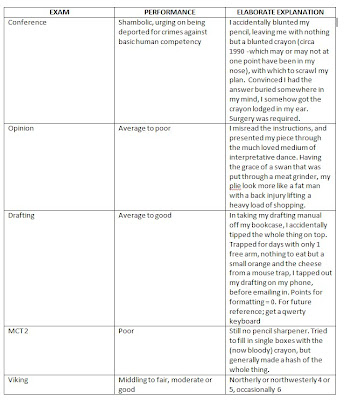
And finally, something to make you smile
So, I'll try something a little different.

And finally, something to make you smile
Tuesday 16 March 2010
Eat, sleep, do exams
I am increasingly aware my blawgging this year has become sporadic, to put it mildly. Now that I am once more clawing back some small semblance of organisation into my life, I will start to post as often as I had hoped. For now, on with the splurge that is my ramblings...
Exams have started to appear with worrying rapidity into my otherwise already busy calendar, leaving me with the prospect of a few weeks propped on coffee, junk food and a pitiful quantity of sleep. If only I can stop the BVC from expanding my wasteline even further, I will not count the year as a total loss.
Chastened by recent poor marks in an opinion mock (gulp), a further poor attempt at drafting (robbed I say, robbed!) and the impending release of the papers on Thursday, I find my waking hours filled with concerns as to my upcoming performance. Hopefully my last few sessions of dedicated note taking mixed with blissful self-deprecation (I was recently banned from a library for full blown flagellation, so decided to tone it down) will leave me swimming in the tranquil waters of the mid-VC.
However, these concerns must exit stage left, for it is my negotiation exam tomorrow. 2 hours of tense reading, writing on the evil that is carbon copy paper, followed by 20 minutes of the cut and thrust of negotiation. I still find the whole process artificial, and like many, difficult to really prepare for. Whilst the overall topic is released a week in advance, there is little to do save brush up on the law and print out a few choice notes. The whole experience of the negotiation exam is an odd one; it feels like spending a week reading books and taking notes before being given two hours to climb to the top of a hill and spend 20 minutes wrestling over a pile of someone else's cash.
Lets hope there's at least jelly involved somewhere.
Is it rude to pack a spoon?
Exams have started to appear with worrying rapidity into my otherwise already busy calendar, leaving me with the prospect of a few weeks propped on coffee, junk food and a pitiful quantity of sleep. If only I can stop the BVC from expanding my wasteline even further, I will not count the year as a total loss.
Chastened by recent poor marks in an opinion mock (gulp), a further poor attempt at drafting (robbed I say, robbed!) and the impending release of the papers on Thursday, I find my waking hours filled with concerns as to my upcoming performance. Hopefully my last few sessions of dedicated note taking mixed with blissful self-deprecation (I was recently banned from a library for full blown flagellation, so decided to tone it down) will leave me swimming in the tranquil waters of the mid-VC.
However, these concerns must exit stage left, for it is my negotiation exam tomorrow. 2 hours of tense reading, writing on the evil that is carbon copy paper, followed by 20 minutes of the cut and thrust of negotiation. I still find the whole process artificial, and like many, difficult to really prepare for. Whilst the overall topic is released a week in advance, there is little to do save brush up on the law and print out a few choice notes. The whole experience of the negotiation exam is an odd one; it feels like spending a week reading books and taking notes before being given two hours to climb to the top of a hill and spend 20 minutes wrestling over a pile of someone else's cash.
Lets hope there's at least jelly involved somewhere.
Is it rude to pack a spoon?
Subscribe to:
Posts (Atom)